
Kootenay CSI: Drug recognition experts bode ill for local stoned drivers

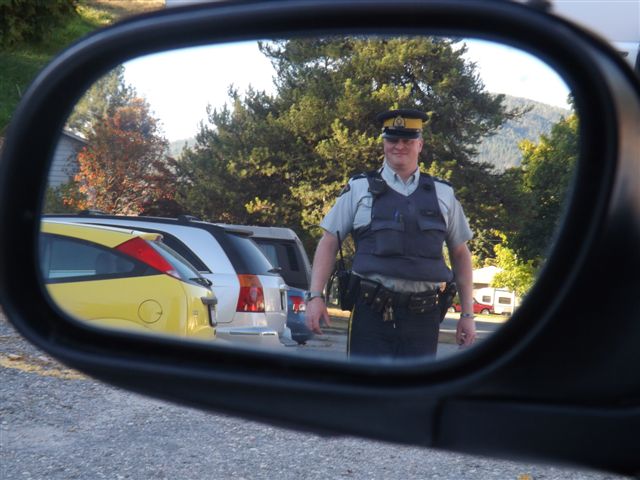
Photo by Kyra Hoggan: If you're driving stoned and this guy pulls you over, you're having a very bad day.

RCMP Cpl. Phil Mager (ironically, pronounced ‘Major’) just came to the Koots in July, and drug users will want to know about him – he’s a drug recognition expert.

Mager is the non-commissioned officer in charge (NCOIC) of the West Kootenay Integrated Road Safety Unit, and part of his mandate is to ensure drug-impaired drivers face the same stiff penalties as do their alcohol-impaired brethren.

“I’m on call and available to any detachment that needs my services, including the Nelson PD and Border Services,” he said, adding his coverage area includes Castlegar, Trail, Nelson, Rossland – in fact it runs from Kaslo all the way to the U.S. border.

How it works is this – if an officer pulls you over and develops the opinion you’re impaired, then via breathalyzer determines it’s not alcohol impairment, you don’t to go home. Instead, you’re brought before Mager or one of the other three drug recognition experts (DREs) in the region, who then undertake a scientific evaluation process to determine a) if you are, indeed, impaired; b) if you are impaired by a drug; and c)what category of drug is causing your impairment. The range here is remarkable, including everything from legal prescription drugs (under the influence of which you should not be operating motor vehicles) all the way through to illegal narcotics and everything in between – even inhalants like sniffed glue or gas or paint fumes.

The science has been applied in the US since the 1970s, Mager said, and since 1995 in Canada. But until legislation in 2009, you’d have to voluntarily undergo the process. Such is no longer the case.

“That demand (that you go before a DRE) is now the same as a breathalyzer demand – you can be charged with refusal and refusing has the same criminal repercussions,” he explained.

Once before Mager or one of his colleagues, you’ll undergo a 12-step process that includes standardized impairment testing, psychophysical tests, clinical tests, interviews of yourself and the officer who pulled you over, and so forth.

Mager said in some cases, impairment may be due to sleep deprivation or a medical condition, and he has, himself, sent people to be examined by a medical doctor. If, however, his evaluation determines you to be drug impaired, he’ll write a report that will be assessed by a senior DRE. If approved, he’ll require a urine sample from you and recommend impaired charges to Crown Counsel.

He said it’s a time, effort and man-power intensive investigatory process – but well worth it, if it keeps our roads and communities safe.

“As much or more risk is presented by drug impairment as by alcohol impairment. These people are driving erratically, driving dangerously, and causing car crashes,” he said. “We want to stop them from harming themselves and others, and make drug-impaired driving as socially unacceptable as alcohol-impaired driving is today.”

He said part of the rigorous process is to ensure the courts look favourably on a science that’s comparatively new to the Canadian criminal justice system.

“Because this is relatively new legislation, we want to make sure all the steps have been followed and they’re very solid investigations,” he said. “It’s becoming more and more accepted (by the courts). We’re getting some good case law in support of the process.”

He said the training process required to become a DRE is also intensive and rigorous, and they have to be recertified every two years to maintain their designation.

Comments

Objective indications of drug

Objective indications of drug intoxication are less apparent than some external suggestions of drunkenness. Police and highway patrol do not have well-developed methods for testing a person for Xanax, Valium, Ativan, Oxycodone, Percocet or other opiates. Quantifying the amount of a substance is ultimately crucial to providing legal proof that the suspect was operating an automobile while in an impaired state. A Spokane, WA driver faces vehicular assault charging following a DUI incident in which she claims to have just started taking a new medication and fell asleep at the wheel. The driver ran a stop signal before her large SUV collided with a sedan, seriously injuring the elderly female driver who was knocked unconscious and had to be extricated from her vehicle.

So called Experts

I have personal experience with these so called experts, from roadside tests, to in custody expert tests, to going to the hospital for blood tests, all to prove that these "experts" are nothing more than glorified witch hunters, and to top it all off, I received a bill from the hospital.  I kindly wrote the hospital and gave them the address of the local detachment, and suggested that they send it there.  Oh, and by the way, no acknowledgement of their mistake, or apology.  Some food for thought, everyone, do you not think that if there was evidence that Cannabis consumers had bad driving practices, while medicated, that the government wouldn't be shoving those studies in all of our faces?  Contrary to being unsafe, States that have implemented medical Cannabis laws have seen a decline in accidents. TIME article, http://healthland.time.com/2011/12/02/why-medical-marijuana-laws-reduce-traffic-deaths/  I would like to see the evidence of Cannabis impairment as I am all for safer roads, and I support good law enforcement practices, but this one has arbitrary written all over it.

TY

well said great sir, case and point. This was what i was exactly talking about. 

i was starting to think everyone on here was uptight and was baised .

What happen to this Blair is exactly what played out in my head thye second i seen this news story. 

Wholly Unscientific

What a waste of taxpayer dollars

I have seen the DRE officers in action. They were totally incorrect with their accusations, accusing a person I know that NEVER does drugs including alcohol, of being high. Couldn't have been more wrong

It's strange how physicians, hospitals and psychiatrists rely of sophisticated chemical analysis to determine if some is high and what drug they are on. Yet the RCMP can train someone in a few weeks, that probably didn't even take a grade 12 science course, how to be a scientist, determine if someone is high or has a mental condition, and exactly what class the drug is that the person supposedly used. Sheer nonsense.

If you believe this I have several bridges, three lakes and a river I can sell you.


From the editor: For Wanker

This is not your first warning ... but it IS your last. If you persist in posting comments with foul language, you will be blocked from the site.

Regards,

Kyra Hoggan

Editor

ha

I do not recall this foul language. Remember you can block this account, but i will always come back. ;)

LOL

I'm delighted by your loyalty, Wanker :)

Using the F-bomb, the S^&t word, etc. just isn't okay. 

Hope you keep coming back, but with a civil tongue.

Regards,

Kyra

the s bomb, c'mon now, don't

the s bomb, c'mon now, don't go all church on me. Sorry sometimes when expressing ones self some people let some stuff slip or "shit" per say. If a person can't swear when they are expressing there opinion then whats the point of freedom of speech etc. If i threated a person directly with swears etc, thats a whole other story.
 

Anyways, What are these 12 steps, how do they work? is there room for error? I do not trust these scientific processes. I just don't want my time wasted by cops like it has already been. 


The Drug Evaluation and Classification program is designed to detect a drug impaired driver and classify the categories of drugs present in his or her system.  edit: here we are, this is not scientific lol

First off: when i see a cop at all, i get jumpy my heart beats faster, my hands shake, my pupils dialate. i get nervous, i may twitch. 
These tests are not at all 100% error free


#12. I would have to read up more on it, but i'm guessing they just test that you have the substance in your body and how much possibly, So? Doesn't mean they were on it at the time. This is just one thing.


The DEC program breaks down detection into a twelve step process that a government-certified Drug Recognition Expert (DRE) can use to determine the category or categories of drugs that a suspect is impaired by. The twelve steps are

  1. Breath Alcohol Test
  2. Interview with Arresting Officer
  3. Preliminary Evaluation
  4. Evaluation of the Eyes
  5. Psychomotor Tests
  6. Vital Signs
  7. Dark Room Examinations
  8. Muscle Tone
  9. Injection Sites
  10. Interrogation of Suspect
  11. Opinion of the Evaluator
  12. Toxicological Examination[2]

Wanker:

I'm laughing now. I get your swearing comment. You have no idea the personal price I pay to keep my colloquial language in check when discussing issues in public - I'm the world's worst potty mouth.

I personally have no issue with cursing - I prefer to judge people less on the words they use than on HOW they use them - one can use kind words to be horrifically cruel, or curse words to say someone looks hot.

But I don't make society's rules - I just run a business that needs to respect them.

I KNOW, from our interactions, that you're smart enough to get that, and smart enough to choose better words. 

Let's work together, 'kay?

Regards, 

Kyra