

Column: Wars and Humankind, Living and Dying

By Charles Jeanes
“We’re fighting wars. We can’t take care of daycare. You can’t do it… We have to take care of one thing: military protection.” — President D. J. Trump, USA
“It takes money to kill bad guys.” — Pete Hegseth, US Secretary of War
“A whole civilization will die tonight, never to be brought back again. I don’t want that to happen, but it probably will…” — President Trump, on Truth Social
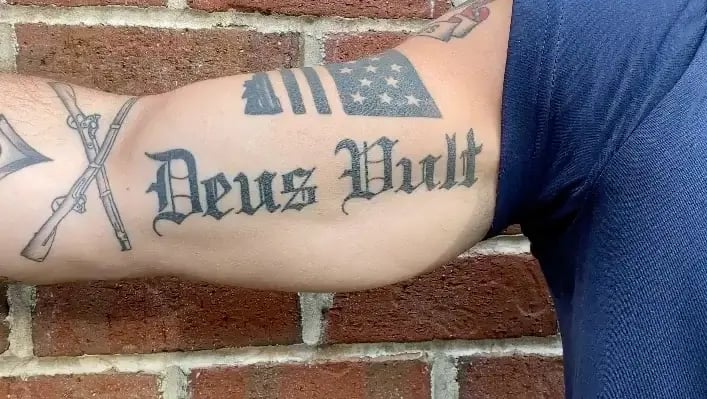
“Deus Vult.” [Latin. = God wills it. ] — tattoo on Pete Hegseth’s bicep (photo — Pete Hegseth on Instagram)
“President Trump has been anointed by Jesus to light the signal fire in Iran to cause Armageddon and mark His return to Earth.” — US army officer [Guardian news report]
War and …
Today I return to the topic of war, the focus of an Arc in early March. News readers know why. Knowing why humans war… is a quite different matter for inquiry.
Reason
Reason has been the deity of the Western intelligentsia since the Enlightenment: Reason, the quintessential human quality. Robespierre worshipped it, explicitly.
Reason was applied to the study of war by intelligent minds; a rational analysis of war reveals its inner secret. The rationalist mind still dominates most histories of war. [ https://svmiller.com/blog/2021/09/rationalist-explanations-war/ ]
One of the enduring proverbs about war came from a Prussian, Carl von Clausewitz: “War is politics pursued by other means.” Mystery solved. Politics explains war; mass violence is an instrument of politics, its goal is achievement of political ends when other methods fail. So – “politics is the source of war” — says Reason.
un-Reason
War appeals to emotion, not the rational mind. Feeling is the true root of human motivation, as stated by twentieth-century revolutionary politicians.
Marinetti, fascist theorist, said “War is the world’s only hygiene.” And Mao Zedong, communist philosopher, said “Revolutionary war is an antitoxin … [it] purges us of our own filth.” Irish revolutionary Patrick Pearse felt a similar attitude to war and its hygienic effect: “bloodshed is a cleansing and a sanctifying thing, and the nation which regards it as the final horror has lost its manhood.”
So – human depravity is the source, not Reason. War is the cure for the disease.
One of the most-awful effects of war – to my mind – has been observed so often it seems almost to be an accepted truth. War gives us meaning. The finest study of that is still the book of that title by Christopher Hedges. There can hardly be a more egregious example of how war nurtures un-Reason in the human being.
https://www.spiritualityandpractice.com/book-reviews/view/5440/war-is-a-force-that-gives-us-meaning
Law
Attempts to make war a matter of legal regulation have a long history. The ancient and medieval worlds had codes of warfare. Greeks, Romans, crusaders: among them all there were well-understood conventions and norms for right conduct in war.
The Geneva Conventions, various Treaties, the League of Nations, and the World Court, have all been products of the European tradition of making war subject to legal restraints. War made for reasons of justice – “just” war – is legal war.
https://www.philosophy.ox.ac.uk/files/rethinkingthejustwarpdf
In 1945, the victors over Germany and Japan took upon themselves the role of law-makers for the world; the United Nations is one result of this urge – the Nuremberg trials another — to organize our globe. The righteousness of particular Allied victors is of course an opinion and not a fact. That post-1945 order is unraveling now; Mark Carney, our P.M. noted the failing order in front of Canada’s European allies.
Battles are regulated by “rules of engagement” under international rules of law.
Pete Hegseth, War Secretary for Donald Trump in charge of the US war in Iran, had this to say: “there will be no stupid rules of engagement.” And: “No quarter; no mercy, and maximum lethality, not legality.” Hegseth also is rabidly born-again-in-Christ.
https://nymag.com/intelligencer/article/iran-pete-hegseth-holy-war.html
Order
War brings Order in its wake, yes? So said many, many thinkers about war and its aftermath over the centuries humans have recorded their histories.
[ See https://walterdorn.net/77-world-order-book-intro ]
The Victor imposes order. In the absence of a victor, chaos might rule the ruins, as scholars could easily see — but the point of war was to produce a Victor who would order the World. Rome’s intelligentsia, like Virgil, believed Rome had a divine mission to order its world. For centuries, Rome never lost a war. Its armies forced order – the Pax Romana – on the defeated. Other war-makers imposed Peace too.
[ https://spectatioblog.com/2017/05/05/review-of-pax-romana-war-peace-and-conquest-in-the-roman-world/ ]
Democracy
It has been a tenet of ideology for the West that our democracies are by their nature less warlike than despotisms, one-party autocracies, totalitarian regimes, sociopath tyrants. I think the point is moot; there is no consensus about democratic pacifism.
Is history a record of peaceful democracies? I tend not to believe this. Ancient Athens, surely, seems to disprove the claim, and the empires of (quasi-)democratic America, Britain, France, and Venice, add evidence to the case against democratic pacifism. A variant of the thesis says democracies tend not to fight each other.
https://www.ekathimerini.com/opinion/1197555/athenian-democracy-makes-us-reflect-on-war-and-peace/
However, this particular argument, that democracy tends to be less militarist and more likely to avoid war than other forms of rule, still has its supporters too. https://www.hawaii.edu/powerkills/DP95.HTM
Empire
Was there ever an empire, ruling expansive territory and a broad variety of peoples, not born from war? No. Empire always originates – at some point – in warfare. No empire’s history is without conquest. Even pacific empires have added to their size by having won a war. They may say the war is defensive, but the end is annexation.
Empire and war are two sides of one coin. Empire is a political organism. So, again, war is politics, as Clausewitz said, and force and coercion are one method of normal politics carried from legislature to battlefield.
Also, imperialist war awakens strong emotion. Temujin, Genghis Khan, the greatest empire-builder and war-winner in history, was definite: “The supreme happiness is to crush your enemies, to drive them before you, to rob them of their wealth, to see their suffering, to rape their women.” Empire-builders are driven by ego, rage, and greed, as Temujin exemplified so well.
And some people see Peace (Latin, Pax) in empire. Europeans, revealingly, called the great Khan’s empire “Pax Mongolica.” They feared him, but admired him as much.
Some empires last centuries as institutions: Assyria, Persia, Rome, China, the Arab caliphs, Turkish sultans, the Indian Mughals. Others last only one leader’s lifespan: Alexander, Attila, Timur-lane, Charlemagne, Napoleon. Regardless, war is part and essence of empire-building and –maintenance. History provides so many examples one is tempted to invoke a “law of imperialist war.” War is creative for empires.
Humanity
War’s violence means death for vast numbers. How could anyone find some moral humanity in this? Humans, in our wonderful mystery, have tried to do so.
Laws of war try to make war more humane and less atrocious. A “just” war, a war with justice in its motivation, is supposed to be morally and reasonably waged.
Rules of war try to regulate “moral” conduct in war. https://voelkerrechtsblog.org/how-law-can-make-war-inhumane-and-banal/
https://scholarship.law.columbia.edu/cgi/viewcontent.cgi?article=1029&context=law_culture
But, as one can see from several declarations by War Secretary Pete Hegseth, for example, moral humanity is not always top of mind for leaders waging war: “no stupid rules of engagement.” He is a crusader and the only law for him is Jesus.
The President was surprisingly candid when he told a journalist that the limit on his power was “my morality.” Here is the quote: “It’s limited by my morality, and I have a very high grade of morality, so therefore it’s limited.” https://www.aol.com/articles/president-trump-says-power-us-020654029.html
Ideology
Humans think. We have ideas. Ideas as ideology help us explain war, to ourselves.
“Let not England forget her precedence, of teaching Nations how to live;” John Milton proclaimed in his writing: a righteous power like England had a mission. Ideology!
Milton, Christian political-thinker-poet, supporter of Puritans in the English Civil War (1641-51), when General Oliver Cromwell had the finest army in Europe. The army had defeated the King; Cromwell put the King on trial and had him executed.
The English mission was to model a good society. The Commonwealth government of Cromwell would teach Europe how to create Christian government. https://go.gale.com/ps/i.do?id=GALE%7CA607064441&sid=googleScholar&v=2.1&it=r&linkaccess=abs&issn=00492949&sw=w&p=AONE&userGroupName=anon%7E7a8a06b1&aty=open-web-entry
Milton believed God chose (“elected”) nations, like Israel, to do His good work. If an elect People made war, God had planned that to happen. (“Providence”)
[ https://www.english-lecturer.com/miltons-paradise-lost/#:~:text=Milton%20was%20Protestant%20so%20believed,truth%20as%20the%20Catholics%20did ] In the event, Cromwell’s rule severely disappointed Milton after 1653.
Religion and war have an old historical relationship; the former motivates the latter. Karen Armstrong, historian, vehemently disagrees that religions cause war.
https://www.bbc.co.uk/ethics/war/religious/holywar.shtml
https://www.intelligencesquared.com/events/karen-armstrong-on-religion-and-the-history-of-violence/
The most-extreme fundamentalist Christian interpretation of the war on Iran has elicited some peculiar statements. An example:
“if Iran threatens Israel, Iran must be destroyed – even, paradoxically, if it results in the destruction of the world. That, folks, is part of the plan.” https://providencemag.com/2026/04/iran-wars-bad-theology/
Then there is the tattoo on Pete Hegseth: “God Wills It.” He also has the crusader’s Jerusalem tattoo, of five crosses, purportedly a medieval symbol. To give the metaphorical middle finger to Islam, he has a new tattoo which says simply – in Arabic script! – “kafir” [“infidel”] It is simple to find photos of Hegseth and his tattoos online, if you want the proof.
Victory
Edwin Starr famously asked in a 60’s protest song, “War – what is it good for?” and replied “absolutely nothing.” https://www.youtube.com/watch?v=01-2pNCZiNk
But victors in a war where the enemy is reduced to total submission often disagree with that, finding great reward in having won at war. The Greeks won against Troy. No Greeks ever regretted their victory, nor Romans their Punic War triumphs.
https://www.hoover.org/research/winning-wars
China’s victory over India in 1962 had a defined objective which China accomplished with ease; war rewarded China with specific territory. Edwin Starr cannot deny that the land China obtained with the border it wanted, is a reward. War is ‘good for’ that. War can have rational goals when the goal is simply to take something from someone else and keep it. Violence can enforce one side’s will over a defeated foe.
Peace
“They create a desert, and they call it peace.” These words were put into the mouth of a Celtic king trying to hold back Rome’s invasion of Caledonia, or north Britannia, two thousand years ago. The king knew Roman history, and the clear pattern of Rome’s expansion over half a millennium: each imperial victory meant a new people crushed into subjection to the Empire City and a new land added to the empire.
The Romans had a succinct summary of their policy toward defeated foes: Vae victis! Woe to the vanquished. The empire got enormous by conquest. The armies of Rome were imperial, were constructing empire, when Rome was republican, not an empire.
Is it false, to say “war makes peace”? America bombed Japan into unconditional surrender; the Allies against Hitler got the same surrender from the Nazis. https://www.archives.gov/milestone-documents/surrender-of-germany
It may have been “the peace of the grave” – – but yes, total victory by one side made an end to that world war.
Devastation, disease, mass migrations and mass death due to lack of shelter or food or medical care, all followed the surrenders, but no more bullets, bombs, or missiles were fired: this was Peace in 1945 [and 1914]. Europe was a ruin… yet, at peace.
It is not profound to say that peace must be more than the absence of war. Yet when people experience the end of force exercised against them and their land, and the cessation of violence by soldiers against other soldiers and against civilians, then yes indeed, absence of war seems a very wonderful thing.
Again, it is not profound, just true: to start war is easy; to make peace very hard.
Intelligence
“The natural state of man is not one of peaceful co-existence but of war – not always open hostilities, but at least an unceasing threat of war” — Emmanuel Kant ( 18th Prussian philosopher)
Kant was a Rationalist, a believer in the power of Reason to resolve human social disorder. He wrote a long tract on how European states might have “perpetual peace” and yet he asserted that war is “the natural state” for our species. Only a reasoned, contrived system, that is, a nurtured/cultural/intellectual acquisition by humans, could deliver human society into the happy state of lasting peace. https://minervawisdomcom.wordpress.com/2020/06/04/immanuel-kant-on-perpetual-peace/
Kant died a long time ago. His legacy of designing a rational blueprint for peace lives on. John Lennon’s song Imagine is a lucid example of the legacy. Words against war.
This thing human beings do in the mortal condition, called War
“We are not human beings having a spiritual experience. We are spiritual beings having a human experience.” ― Pierre Teilhard de Chardin, Jesuit, theologian
In my old age, I find I incline to question basic attitudes I used to accept uncritically. I was once like John Lennon. I was a dreamer of peace by human decision: “War is over if you want it. War is over, nooowwwww.”
John means humans will solve war when we decide it is dead, finished, obsolete.
( Or Cat Stevens in his anthemic song, Peace Train. “Why can’t we live in bliss? ‘Cause out on the edge of darkness — There rides a peace train, Soon it will all be True…” )
In the March edition of Arc I referenced, I declared otherwise. There I concluded I do not think we humans are masters of our own behaviours, nor that with the right, effective nurture and culture and mental interior we will eradicate war. War seems to me a part of who and what we are as a species, and a species alteration alone can end it. I offered a solution no one can yet accomplish – re-make the human being.
I am tolerant now of a conclusion I wouldn’t accept in my youth, that war can’t be limited and regulated by human institutions when powerful States accept that. I now think war is inherently a piece of the human condition, not to be changed.
War is one of many paths to our mortal end. We die. We are probably not hoping that our end will be in combat, but many cultures indeed do inculcate a view of death in war as noble and valuable.
I think of death in war as meaningless in more cases than not. The warrior or civilian who dies thinking their death is significant, is most likely a very thoroughly indoctrinated individual. I do not believe in the sacrificial nature of death in war. If you think no one believes in it, you have not listened to the rhetoric offered up every Remembrance Day at Nelson cenotaph in the past.
In the film Clockwork Orange, the protagonist is rendered incapable of violence by scientific manipulation of his psyche; by the film’s end, he has escaped the leash.
One reviewer sums it up thus: “A Clockwork Orange” takes us on a riveting journey through the human condition, plunging into profound inquiries about free will, morality, authority, and redemption.” https://medium.com/@rinoingenito04/beyond-the-bowler-hat-how-a-clockwork-orange-rewired-cinemas-moral-compass-67fa16c0e29e
Conclusions
We are stuck in this condition, being human. War will never stop engaging some of our finest minds in exploration of the why of it and the path to its extinction. The conversation will continue indefinitely. I personally expect no resolution.
Molecular genetic science now suggests that life alters a single human’s genome. If an individual is transformed at the molecular level by the life he/she leads, then there is indeed a possibility all humans might be altered into a new species.
A species called homo sapiens that is not capable of war is not homo sapiens but a transformed species, a new species. I suggest we call it homo pacificus.
Meanwhile, should a reader want me to conclude with some succinct advice relating to war and peace, I will cop out and quote someone else: “whatever your labors and aspirations, in the noisy confusion of life, keep peace in your soul. … do not distress yourself with dark imaginings. Many fears are born of fatigue and loneliness.”
https://en.wikisource.org/wiki/Desiderata
—————————————————————–
Appendix:
time-consuming videos on violence, war, humans
Watch Clockwork Orange https://www.tcm.com/watchtcm/titles/71092
Historians
Historian Margaret Macmillan interviewed – author of histories of wars.
https://www.youtube.com/watch?v=oXKIE0re5dw
Victor Hanson on war in history.
https://www.youtube.com/watch?v=j2SXTl63nlA
Yuval Harari on human history and behaviour.
https://www.youtube.com/watch?v=Mde2q7GFCrw
Niall Ferguson on wars ahead.
https://www.youtube.com/watch?v=YnzNYj5uWts
Three historians interviewed about history. (V. Hanson, N. Ferguson, A. Roberts)
https://www.youtube.com/watch?v=9PrzDICJ4Kk
Three free books on the subject of War. Recommended by Arc’s writer.
https://www.psicopolis.com/PSIPOL/boxpdf/terrlovwar.pdf
https://www.psicopolis.com/PSIPOL/boxpdf/terrlovwar.pdf
Authors are 1. Chris Hedges. 2. James Hillman. 3. Barbara Ehrenreich.























Comments